
“The solar power industry has been driving decarbonization for decades. I can’t wait to hear what they have to say about sustainability.”
That’s what I told Sheila Ongie, our Head of Strategy, when she suggested I speak at the Solar Energy Industries Association (SEIA) Sustainability Conference in Charlotte, North Carolina, a couple of weeks ago. I was not disappointed. The conference turned out to be a room full of committed, knowledgeable sustainability professionals who know exactly how much is riding on getting this right.
It was also a community facing some new and complicated questions. Solar has grown big enough to face the kind of scrutiny that was more commonly directed at fossil fuels: Where do raw materials come from, what happens to equipment at end of life, and who gets a say in where it builds?
Here are a few of my takeaways:
Supply chain concerns are real
“We’ve been too busy cutting carbon to grapple with our own carbon footprint.”
I heard some variation of this several times during the conference. A number of industry insiders explained to me that they are further behind than they, or their customers, would like in terms of supply chain sustainability. Yet as the industry has matured, customers, regulators, and investors are starting to ask more questions:
- What do Scope 1, 2, and 3 emissions look like?
- Where are polysilicon, silver, and other critical materials sourced from?
- How are conflict minerals or labor issues monitored?
In a fascinating panel moderated by Tiffany Buck, Director of Sustainability at leading solar energy developer Arevon, panelists explored the complex tradeoffs involved in solar infrastructure development. Emily Sharp, HSSE Manager at Total Quality Logistics talked about the challenges in balancing the cost, performance, reliability, and greenhouse gas implications of intermodal shipping — not least when a customer wants transportation by rail, but the nearest rail depot is 500 miles away. Meanwhile, Alyssa Grant Schott, Director of Impact at SOLV Energy emphasized the value of undertaking a double materiality assessment (DMA) to gain a more holistic understanding of impact.
The practical lesson was clear: The earlier you start mapping your impacts and risks, and making sure you deeply understand potential tradeoffs and stakeholder demands, the easier it becomes to manage them before customers and investors come asking.
Will solar sustain the countryside, or consume it?
The increased scrutiny the industry is facing should not come as a surprise. Solar is no longer the plucky underdog. It’s the fastest-growing source of electricity generation in the world. As such, stakeholders are rightly taking a closer look, with one of the most often cited concerns being the impact of grid-scale solar on the rural landscape and economy.
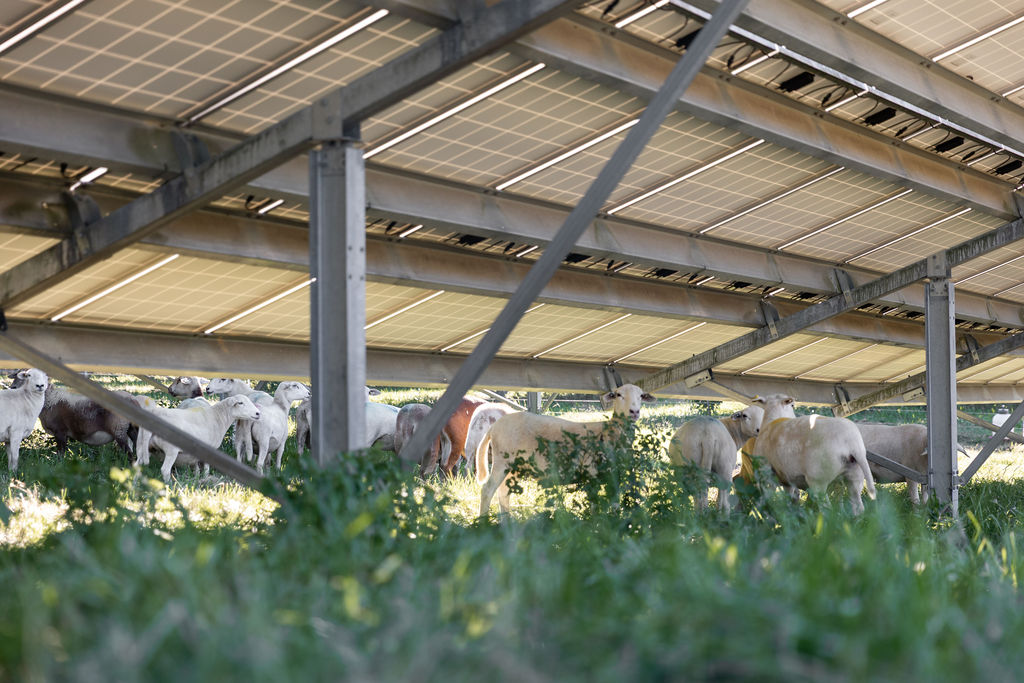
Yet as Matt Abele, Executive Director of the North Carolina Sustainable Energy Association explained to attendees, the narrative of “Big Solar” gobbling up farmland is overly simplistic. Farmers can earn 10 to 14 times more per acre from solar than from grazing, Matt said, but that doesn’t mean they are selling the farm. More often than not, solar becomes an additional income stream that relieves pressure to sell off land for permanent development. (And that’s before we even get into the topic of agrivoltaics, where solar electricity generation and traditional farming practices are integrated.)
The conclusion I came to was simple: The industry needs to get much better at communicating its true value not just in terms of decarbonization, but rural economic development, too. From hard numbers on lease income and acreage kept in production, to high profile agrivoltaics pilots (ideally with some photogenic farm animals!), there are opportunities to reframe the narrative and invite communities in to participate.
‘Recoverable’ is not the same as ‘recovered’
Unsurprisingly, end-of-life and decommissioning was one of the most prominent topics at the conference. Attendees who had attended in previous years told me, however, that the conversation has shifted. They said that previously, the focus has often been on what’s possible. What can be recycled? How can we design products and installations for recyclability? How do we build the infrastructure to make it happen? Increasingly, however, the focus is shifting to what’s measurable and verifiable.
If that sounds familiar, it’s because consumer brands have spent years in court over the gap between ‘recyclable’ and ‘actually recycled.’ Scott Azevedo, Senior Manager of Strategic Procurement at Intertek CEA explained how his team set up the industry’s first independent PV module recycling verification program to quantify and track the inputs and outputs of recycling and recovery. That kind of verification is what makes a circularity claim defensible.
For anyone communicating about end of life, the focus is on real-world feasibility and verification: don’t say "recyclable" or "recoverable" when you can’t yet say how or even if it’s going to actually happen.
One person, 50 sites
Given the recurring theme throughout the conference of increased scrutiny, it made sense that several panels focused on stakeholder engagement and community relations. Perhaps the most striking soundbite on this topic came from Tom Weirich, Head of External Affairs for CoVolt Power. Oil and gas companies, Tom told the room, typically employ one community relations representative for every nine projects. He then asked the audience what they thought the average might be for solar developers. The answer: one for every 50 sites!
From fears about solar farms dominating the landscape to wildfire risk at battery storage sites, Tom and his fellow panelists pointed to a wide variety of legitimate stakeholder concerns, and encouraged attendees to take a more proactive role in community relations.
The practical implication: Companies need to invest significant resources in maintaining their social license to operate. From hiring more community relations roles to making sure communities see real economic benefits, there are many levers that can be pulled. The key, however, is to ensure you have an intentional, proactive, people-centered strategy for engagement.
Compliance is not a strategy
As with many industries, solar companies are navigating a growing patchwork of regulations, and it can be easy to get lost in the weeds. Yet as James Flores, Director of Environment and Sustainability at EDF power solutions North America argued in his talk, it’s important to keep an eye on the bigger picture. While regulations may compel you to track or disclose your carbon footprint or energy spend, the real value comes in understanding what those numbers are telling you, staying out ahead of regulatory pressures, and seizing the opportunity to refine and enhance your business strategy.
The topic came up later during a panel I was on, which looked at reporting frameworks and regulations. As all panelists agreed, it’s much easier to comply with regulations when you have a granular understanding of your operations, strong relationships with your customers and suppliers, and you’ve been proactively managing material topics.
Here’s how I summarized this takeaway on the panel: As a human, I don’t walk around trying not to do crime. Instead, I try to be a good person and a productive member of society. Fellow panelist Ilya Krasnoyarov, Director of Renewables Investments at Mortenson Properties agreed: Regulations or frameworks might require certain things, but the bigger picture is that decarbonization and sustainability are a societal imperative and the right thing to do, and they also happen to offer a huge opportunity for those who are ready to seize it.
What comes next
I drove home from Charlotte with a lot to think about, and with a strong urge to get deeply involved in the next phase of solar and sustainability. In conversations at the conference, and in follow-up calls since, I heard from an industry that knows it is being held to a higher standard and appears to welcome that. Solar has survived a few hostile years in politics and policy, and it isn’t going anywhere. But as attendee after attendee told me, an industry that is this central to decarbonization will be expected to show its work on sustainability. The companies that are able to answer those questions now will be in a much stronger position when the next round of scrutiny arrives.
If you’re part of the industry and grappling with how, I would love to serve as a sounding board. Reach out at sami@thinkparallax.com or on LinkedIn, and let’s find a time to dream big. Also, be sure to look out for me at the next SEIA Sustainability Conference in early October 2027. I honestly can’t wait.
Sami Grover is Director of Communications Strategy at thinkPARALLAX, where he helps clients to position and communicate their sustainability efforts to advance their strategic business goals and maximize their positive impact on the world.