
Intro
Corporate sustainability is navigating one of its most turbulent periods in decades. In the United States, the current administration has systematically vacated federal climate and ESG-related regulations, including the SEC’s climate disclosure rule and executive orders directing federal agencies to deprioritize environmental and social considerations in procurement and investment.
Meanwhile, a wave of anti-ESG legislation at the state level in mostly Republican states, and legal challenges to sustainability-focused legislation in Democratic states, has created a fragmented and legally uncertain operating environment for companies with public sustainability commitments.
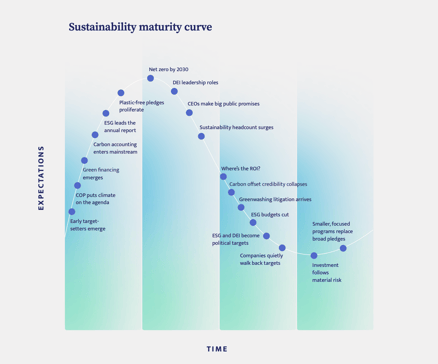
In response, major corporations — including some that were once considered sustainability leaders — have quietly shelved net-zero pledges, withdrawn from climate coalitions, and scaled back public-facing sustainability reporting. The result is continued questioning about what corporate sustainability means, what it requires, and whether it’s worth the effort. However, while politicians roll back climate regulations and boardrooms quietly distance themselves from sustainability commitments, customers remain steadfast in their priorities.
According to NYU Stern’s Sustainable Market Share Index™ 2025 Report, sustainability-marketed products now hold 25.4% of the branded CPG market and have grown 4.9-times faster than conventional products since 2010, driving nearly half of all CPG market growth. This trend has held firm through inflation, a pandemic, and economic volatility. The sustainable consumer is no longer a niche — it spans generations and income levels.
A global survey by PwC found that nearly 80% of consumers say they would pay a premium for sustainably produced goods and that number climbs among younger demographics who represent the next wave of purchasing power (PwC Voice of the Consumer Survey, 2024).
But even more significant than consumer product-level appetite for sustainability is a continued desire to buy from, support, work for, or partner with companies that are doing good. Sustainability remains key to positive brand reputation, and that has not wavered, despite political shifts.
As uncomfortable as this moment feels for sustainability professionals, it may be exactly the reset that corporate sustainability needs. The current pullback creates space to stop, ask hard questions, and rebuild a sustainability strategy that is tightly connected to how the business creates value. Companies that built sprawling sustainability programs under pressure, committing to goals that outpaced their operational reality and publishing reports driven more by benchmarking anxiety than strategic clarity, are now being given the opportunity to do something more valuable.
Companies that use this moment to sharpen their focus, concentrate resources on the programs that drive real outcomes, and deprioritize the performative ones won’t just survive the current political environment but will emerge with a more durable, credible, and effective sustainability practice.

Impact is your competitive advantage
What two decades of reputation research reveals about how positive impact drives business value.
For twenty years, reputation research has pointed to the same conclusion: companies that demonstrate positive impact outperform those that don’t — not just in public perception, but in measurable business outcomes. The data that follows draws on that body of research to show exactly where and how impact creates advantage, from purchase intent to pricing power to resilience in a crisis.
Here's where to start.
STEP 1: Realize the action customers want
When companies are thinking about sustainability communications, the instinct is often to lead with products — certifications, ingredients, packaging. But customers are evaluating more than what you sell; they’re evaluating who is selling it.
When customers demand action on sustainability, they want to see it from the company itself — not just its products. This distinction matters because corporate perception drives more purchasing behavior than most companies realize. Over 60% of consumer decision-making, including purchase intent, loyalty, and willingness to pay a premium, can be explained by perceptions of the company behind the products and services they buy. That means sustainability initiatives at the corporate level aren’t just good citizenship. They’re a direct lever on commercial outcomes.
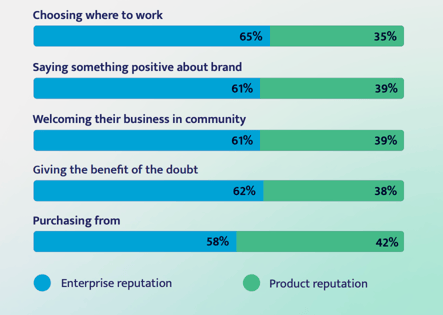
According to Reputation Economy Advisors research, since 2011, who you are matters more than what you sell
Enterprise versus product perception
When consumers decide whether to buy, work for, or recommend a company, their perception of the enterprise — not the product — is the dominant factor. Across every decision type, from purchase intent to employer consideration, company-level reputation outweighs product perception by a significant margin. Who you are matters more than what you sell.
What drives consumers:
STEP 2: Establish a platform
Second, companies need to establish a platform that extends beyond their products and services — one that positions them as an organization genuinely trying to do good for society. This means building consistent, visible proof that the company is contributing positively to the world around it.
The threshold to clear is simpler than it sounds: When a customer can answer yes — unprompted — to a question like “does this company engage in any environmental, community, or economic initiatives?”, behavior shifts meaningfully. Awareness alone moves the needle.
The research bears this out. Customers who are aware of a company’s positive impact actions are more likely to give it a strong reputation score, say they would purchase its products, and say they would recommend it to others. And the effect is growing — the impact of positive impact awareness has increased year over year, suggesting that as public attention to these issues rises, the reward for visible action rises with it.
Impact of positive impact & sustainability awareness on KPIs
Sustainability awareness doesn’t just improve perception — it moves the metrics that matter. Among consumers aware of a company’s positive impact and sustainability initiatives, purchase intent jumps 19% and advocacy climbs 30%. Knowing what a company stands for changes what people do next.
+19% rise in purchase intent among those aware of company’s sustainability
+30% rise in advocacy among those aware of a company’s sustainability
STEP 3: Focus on communications
Third, breaking through requires focus. With limited attention and no shortage of competing messages, spreading communications across too many initiatives dilutes impact. To move the needle on positive impact awareness, companies need to concentrate on one or two topics where they can lead and then stay on them, consistently and with intention.
This discipline doesn’t come naturally. PR and communications teams are often managing a broad portfolio of initiatives and feel pressure to give each one airtime. But the research is clear: targeted, always-on communications around a focused set of initiatives outperform scattered efforts every time.
The key is choosing the right initiatives to focus on. The highest-potential candidates share three traits: they have meaningful impact on your target metric, they have room to grow because awareness is still relatively low, and they’re backed by strong, credible proof points. Finding the overlap between those three criteria — and then committing to it — is where sustainable communications strategies find their leverage.
Not all initiatives are created equal
When it comes to reputation lift, environmental initiatives punch above their weight. Data shows that even sustainability programs with low public awareness can deliver significant reputation gains — in some cases outperforming social initiatives that are far more widely known.
STEP 4: Quantify, capture, and communicate internally
Lastly, it’s crucial to take the time to quantify, capture, and communicate successes internally in a way that builds the organization’s appetite to fuel continued investment for impact.
Case studies: Leveraging positive impact to drive sales
Turning sustainability into advocacy: Facing a potential excise tax in a Southeast Asian country, the local government relations team turned to their communications colleagues to activate public support for the company. Leveraging insight that identified which sustainability initiatives were most effective, the team ran a PR and marketing campaign to secure enough advocacy from the public to stop the unfair tax.
Turning local impact into brand defense: Facing backlash from anti-American sentiment due to trade and international conflict, including consumer boycotts (20% or more declines in purchase intent), a number of big players have been emphasizing their local economic footprint and (even better) tying it to their environmental sustainability initiatives. This has begun to counteract the backlash and mitigate declines in sales.
How traceability became a market share lever: With their in-person sales force facing increasing competition from an explosion of competitors, the company needed to find a way to differentiate more than just their products. Leveraging insights that showed target consumer interest in sustainable and traceable ingredients, the company began to share details and proof points for their natural, traceable ingredients throughout the supply chain. This turned an operational, cost-driven sustainability initiative into a lever to drive sales and market share.

How to leverage your impact
How to tell a story that will move the needle
If positive reputation is built by leveraging a strong sustainability/impact story, then the next logical question is, what should we build that reputation around—and, importantly, what exactly are we aiming to achieve?
Clarify.
Are we are losing ground with a key customer segment? Do we face community opposition that is slowing a critical project? Are we are losing top talent to competitors with stronger purpose narratives? From there, the work is to map the audience that holds the key to solving that challenge, understand what they currently believe about your company, and define what shift in perception or behavior would constitute success.
Strategize.
Then build your impact strategy from there. The right strategy connects your most credible, relevant impact to the concern or aspiration that matters most to the specific audience you’re trying to move. It identifies personas and the messages that will resonate, the messenger who will be believed, and the channel through which that message will travel most effectively. Your strategy should account for what your peers are saying, where the white spaces are, and where your company has a genuine right to lead.
Engage.
If your team isn’t talking about it, it won’t move the needle. Engagement can look like activating sales teams who can embed sustainability proof points into customer conversations, marketing functions who can carry the narrative across paid, owned, and earned channels, and corporate leadership who can model and amplify the message with credibility and conviction. It also means identifying and investing in the external audiences who are most likely to carry your message onward, like employees, community advocates, and sector influencers who can extend your reach into the rooms and relationships you can’t access directly.
The current moment in corporate sustainability is uncomfortable. The political headwinds are real. The legal uncertainty is real. The pressure to go quiet is real. But the companies that will emerge strongest from this period are not the ones that stay silent. They are the ones that get precise. They stop trying to be everything to everyone on sustainability, and start being exactly the right thing to exactly the right people, in service of outcomes that matter to the business.
Most companies sitting on genuine sustainability impact are underleveraging it. They have yet to connect it to a specific business goal, a specific audience, or a specific ask.
About
thinkPARALLAX
thinkPARALLAX is a full-service strategy and communications agency on a mission to help companies get started and accelerate their sustainability journey. We’re a team of sustainability experts, communication strategists, and brand-savvy designers dedicated to making sustainability business as usual. We partner with influential companies across industries to build customized sustainability strategies, roadmaps, programs, reports, engagement, and communications, aligned to a company’s unique ambitions, brand, and business.
Reputation Economy Advisors
We coined the term “Reputation Economy” in 2010 to capture our new reality — where a timeless concept has become the single most important driver of corporate value. Our experience and exposure to the biggest, most complex organizations on earth during the evolution of the Reputation Economy puts us in a unique position to help executives responsible for Reputation succeed. We’ve been on the client side of the Reputation equation, built the world’s first Reputation-based management consultancy, and have worked with most of the companies who’ve “figured it out”. If you’re looking to ensure your Reputation metrics are used to make smarter investment decisions, leverage Reputation-driven messaging to drive growth, or improve your organization’s Reputation risk capabilities, we’ve seen it all and are here to support your journey.
Authors
Janna Irons, Head of Communication & Brand at thinkPARALLAX
Anthony Johndrow, Co-founder and CEO of Reputation Economy Advisors