

We recently walked through the IPCC's five climate scenarios: five "what if," hypothetical stories about how the world might develop, paired with the emissions trajectory that story would produce. They're excellent at answering "how hot does the planet get, and what does that mean physically," but what they don’t answer is the question most businesses actually lose sleep over: what does that mean for revenue, cost, and creditworthiness? That gap is addressed by the Network for Greening the Financial System (NGFS) scenarios, yet another set of climate scenarios. tPX uses both the IPCC and NGFS frameworks in our work and finds each to be helpful for different dimensions of climate risk.
Who is the NGFS, and who are these scenarios for?
The NGFS is a coalition of central banks and over 140 financial supervisors that came together in 2017 to help the financial system understand and manage climate-related risk. To do that, they needed a shared set of scenarios everyone could model against, so they partnered with an expert group of climate scientists and economists to build one.
The scenarios were originally aimed at central banks and supervisors running climate stress tests on the banking and insurance sectors. But the same qualities that make them useful for a regulator, like financial variables, sector-level detail, a structured way to compare transition and physical risk, make them just as useful for a company trying to translate climate change into board-level, balance-sheet language.
The long-term scenarios
NGFS's flagship product is a set of long-term scenarios stretching to 2050 and beyond. They give a common, up-to-date reference point for how two things might evolve together: physical risk (the changing climate itself) and transition risk (how climate policy and technology shift in response). Each scenario was deliberately chosen to represent a different mix of higher and lower risk on both fronts.
The scenarios sort into four families, based on how coordinated (or not) the policy response is, and how much physical damage results:
- Orderly: policy tightens early and predictably; both physical and transition risk stay relatively contained.
- Disorderly: policy action is delayed, then has to move fast, driving up transition risk (steeper carbon prices, faster stranded-asset risk) even as physical risk stays moderate.
- Too little, too late: countries act, but in an uncoordinated, fragmented way, leaving both physical and transition risk elevated.
- Hot house world: policy stalls at today's level (or close to it), so transition risk stays low, but physical risk climbs the highest of any pathway.
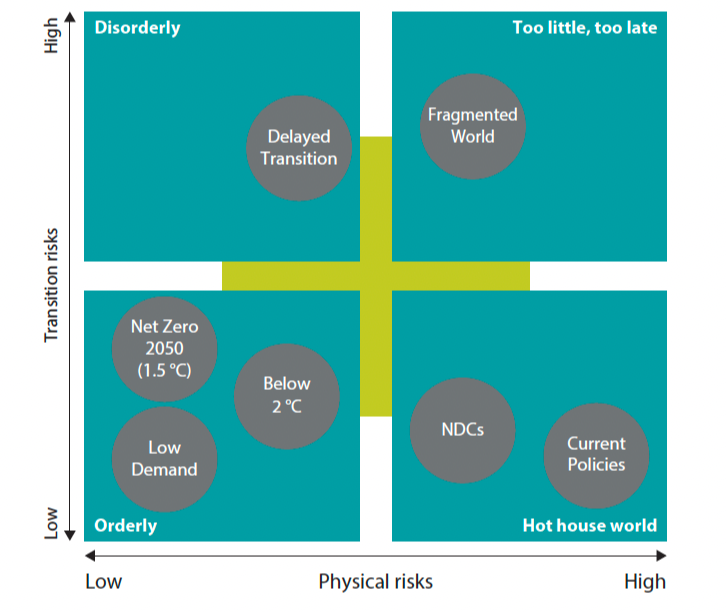
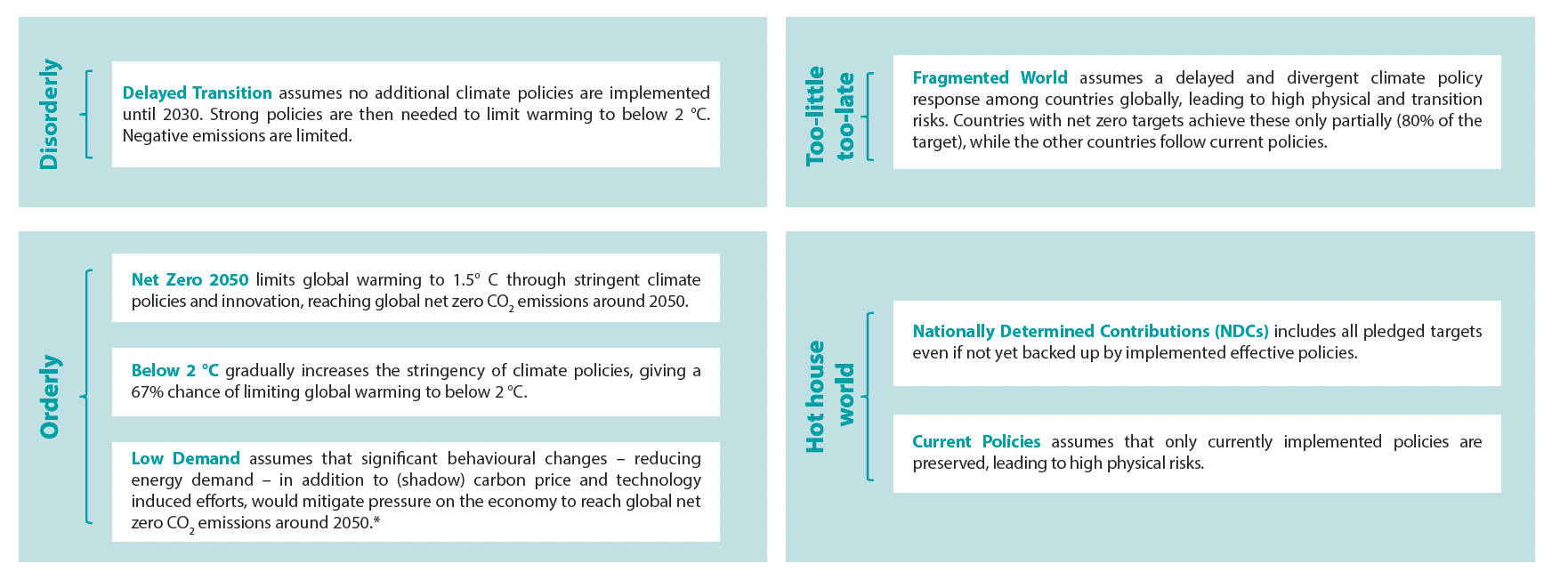
The seven long-term NGFS scenarios, each of which explores a different set of assumptions for how climate policies, emissions, temperatures and physical risk impacts evolve.
The short-term scenarios (new as of 2025)
For years, the long-term scenarios were the only NGFS product available, which was a real limitation for anyone trying to understand what climate change and the transition do to the economy in the next five years, not the next 50. NGFS closed that gap with a new short-term scenario set, purpose-built for a policy-relevant, business-planning timeframe.
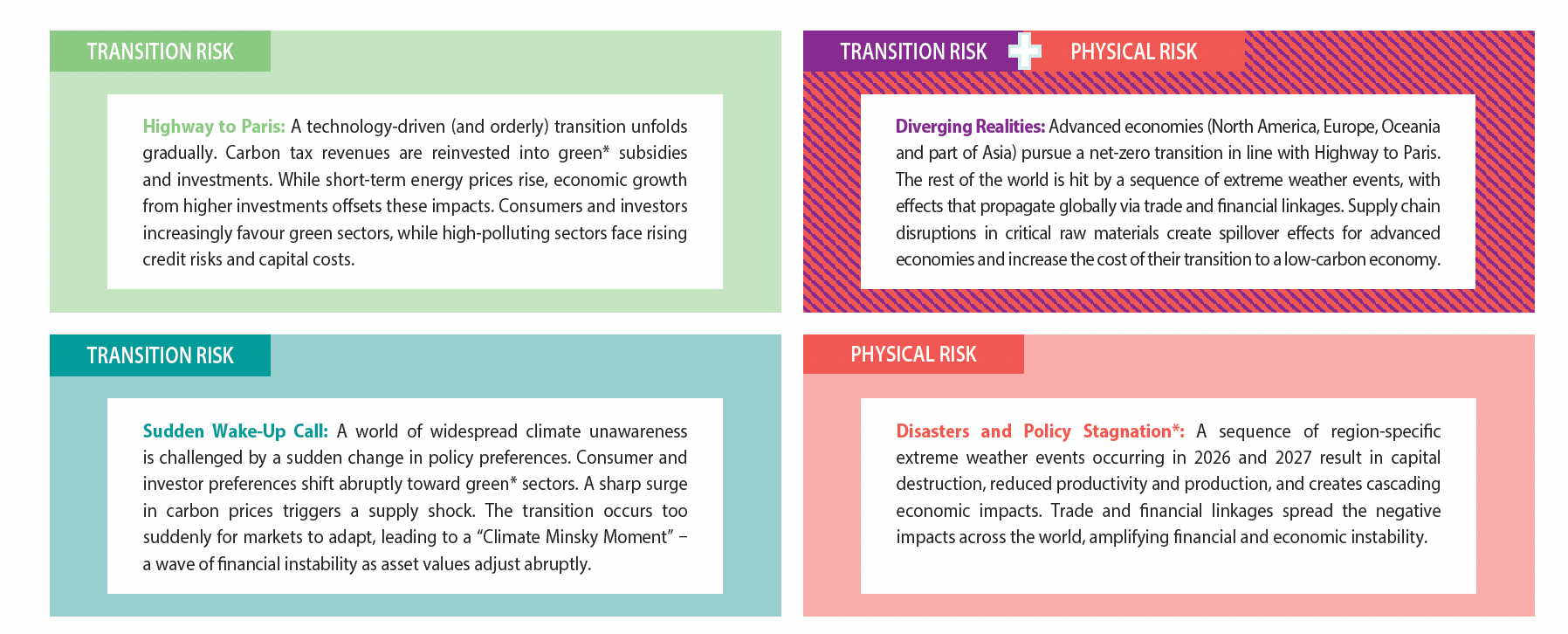
The baseline of the short-term scenarios incorporates climate targets committed by January 2023. They shed light on possible avenues for trying to achieve 2030 emission reductions that align with 2050 net-zero targets and physical risk scenarios associated with severe and compound region-specific extreme weather events.
A few things make the short-term scenarios different from the long-term ones:
- They model compound extreme events — a heatwave, drought, and wildfire hitting in the same window of time, for example.
- They capture cross-regional spillovers, tracing how a shock in one region moves through trade and financial linkages to hit others.
- They're built to study how climate risk interacts with the ordinary business cycle, layering climate policy, extreme weather, and sector-level economic dynamics on top of each other.
- They come with granular sectoral and country-level data that a century-scale scenario typically can’t provide.
The short-term scenarios are most useful for stress-testing near-term financial resilience or trying to understand how a plausible bad year (or two) could ripple through a business. The long-term scenarios, on the other hand, can help answer more structural questions around how a business model holds up over decades of transition, or how a strategic decision plays out under sustained policy and technology change. Most thorough assessments end up using both.
Why to use NGFS for climate risk assessments
At tPX, climate risk assessments are meant to help clients plan. The NGFS's macro-financial framing is useful since it maps physical vs. transition risk into four named families and gives a client an intuitive way to talk about which future they are planning for without getting lost in climate models or emissions data. The four families also make it easy to pick a diverse pair of scenarios (one lower-risk, one higher-risk, usually from different quadrants) to stay consistent with TCFD's guidance to avoid stress-testing against a single, comfortable story.
Why the IPCC and NGFS climate scenarios are complementary
If the IPCC tells you how hot the planet gets, NGFS tells you what that means for the business next to you. Neither replaces the other and the strongest climate risk assessments we've seen use IPCC scenarios to ground the physical story and NGFS to translate it into the financial and strategic variables a leadership team can actually act on.
Sources: NGFS Scenarios Portal — Explore
NGFS — Short-term Climate Scenarios for central banks and supervisors
NGFS Climate Scenarios Technical Documentation, v5.0 (Nov 2024)
NGFS press release — latest long-term climate macro-financial scenarios
Forvis Mazars — NGFS Phase V climate risk scenarios
Munich Re — IPCC vs NGFS climate scenarios
Shara is a Senior Strategist at thinkPARALLAX with a decade of cross-functional experience across energy, climate, food systems, and technology. Her client experience includes leading brands such as Panera, Campbell's, Ferrara, Snap, and Dematic, where she helps companies translate complex science, sustainability strategy, and business performance into stories that resonate. She believes lasting change is driven from within and that the right narrative can help companies build momentum and unlock value for the betterment of all.